



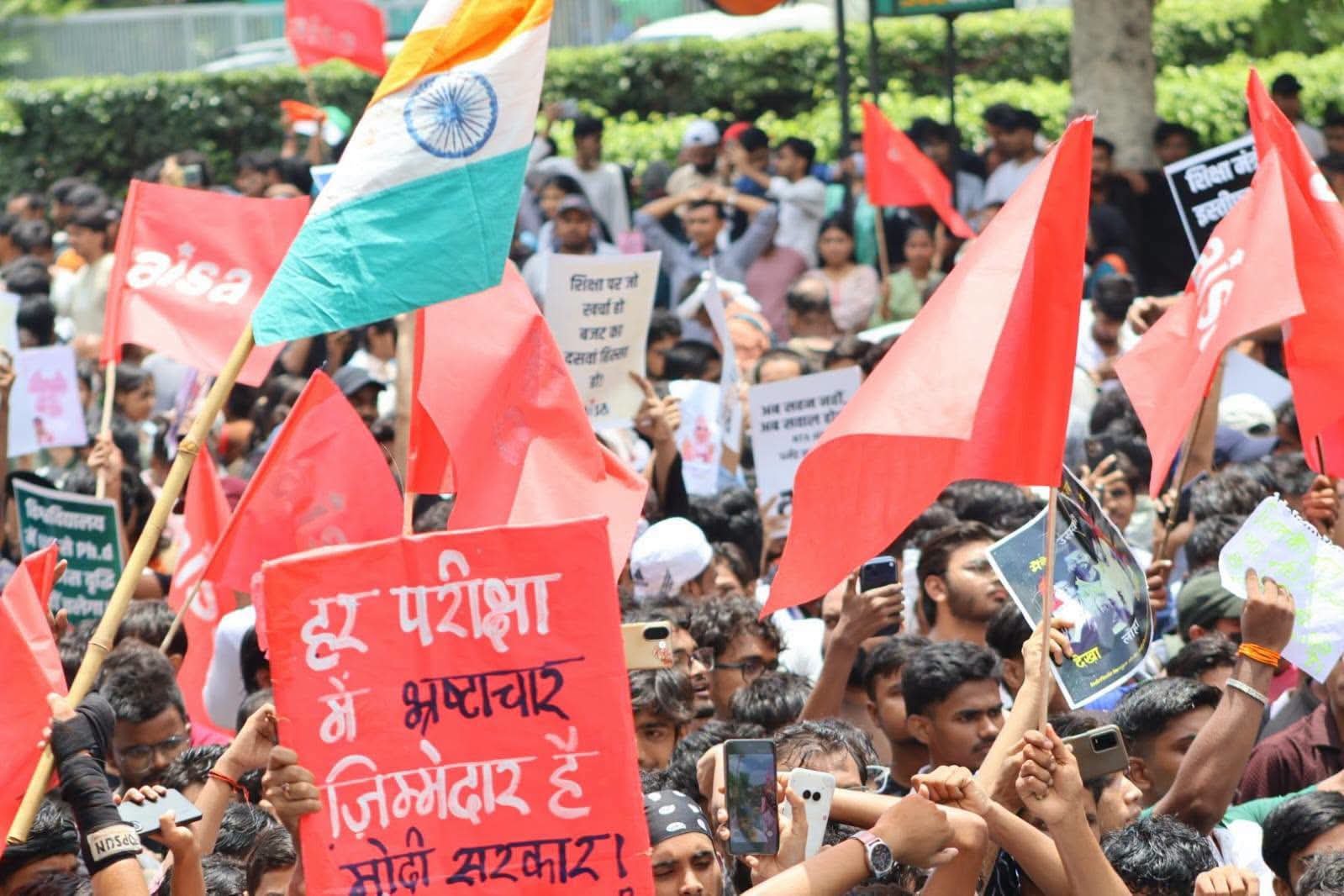
[23/07, 1:14 am] Harmeet Salyal Journalist: The Bihar Police on Wednesday used batons, water cannons and tear gas to crack down on hundreds of activists of the All India Students’ Association (AISA), who took to the streets of Patna demanding the resignation of Union Education Minister Dharmendra Pradhan over the NEET paper leak and expressing solidarity with protesters in Delhi.
Hundreds of AISA activists first gathered at Gandhi Maidan before attempting to march towards Lok Bhavan. The protest was led by AISA Bihar State president Dhananjay, state secretary Dipankar and vice-president Saba Afrin.
The demonstrators marched towards Lok Bhavan via Bailey Road despite heavy deployment of security personnel at Dak Bungalow. At several points along the route, the police used water cannons, tear gas and baton-charge to disperse the protesters.
“Bihar Rises Against the Modi Government’s War on Students and Youth. On July 22, hundreds of AISA activists, along with students and youth, marched through Patna despite police repression, condemning the fascist police brutality unleashed during the July 20 Parliament March in Delhi and demanding better education and accountability,” CPIML Liberation wrote on X.
Despite the police action, the protesters managed to reach the vicinity of Lok Bhavan and the Chief Minister’s residence during the ongoing Monsoon Session of the Bihar Legislature.
Several students, including AISA leaders, sustained injuries in the police action and were admitted to Patna Medical College and Hospital (PMCH).
[23/07, 1:18 am] Harmeet Salyal Journalist: The Supreme Court on Wednesday refused to urgently list a petition challenging the Delhi Police’s action against students protesting in the national capital, with Chief Justice of India Surya Kant telling the petitioner’s counsel, “Don’t waste our time, and don’t waste your time.”
Interestingly, the Cockroach Janta Party (CJP), which is leading the ongoing protests, emerged after Chief Justice of India Surya Kant’s controversial remarks comparing frustrated, unemployed youth to “cockroaches” and “parasites.”
The petition concerns the police crackdown on students participating in protests organised by the Cockroach Janata Party (CJP), which has been demanding the resignation of Union Education Minister Dharmendra Pradhan over alleged examination paper leaks.
During the mention, the petitioner’s counsel submitted that the students were raising important issues, including the conduct of the NEET examination and reforms in the National Testing Agency (NTA).
When the counsel referred to videos purportedly showing police brutality against the protesters, the Chief Justice responded, “We are not interested in videos; we don’t have time to watch.”
As the lawyer attempted to continue the submissions, the Bench concluded the exchange by saying, “Thank you very much.”
The Supreme Court’s refusal to urgently list the plea triggered sharp reactions from activists, journalists and supporters of the Cockroach Janta Party (CJP) on social media.
CJP founder Abhijit Dipak responded to the development with a series of question marks (“???????????”).
Journalist Rajdeep Sardesai questioned the Court’s priorities, writing, “Don’t forget it took the CJI’s reference to the word ‘cockroach’ to finally trigger youth protests. Now when videos of students allegedly being beaten or dragged were cited, the court says it has no time to watch them. Makes you wonder: what does our justice system choose to prioritise?”
CJP spokesperson Saurav Das described the Chief Justice’s remarks as “a blot on our democracy” and said, “Surya Kant ji must realise that so much arrogance is not good. Government of India must counsel him.”
AAP leader and Supreme Court lawyer Somnath Bharti called it “a dangerous situation.”
“If Hon’ble CJI won’t listen to such issues then who will? And this brings a larger question before the people of India—does a court have a choice to listen or not to listen to issues against the people in power?” Bharti wrote on X.
He argued that while courts are free to decide cases on their merits, the High Courts and the Supreme Court are “duty bound to give a patient hearing” to issues “as important as brutalities committed on students yesterday.”
YouTuber Akshay Saini criticised the Court’s response, arguing that students protesting for “basic exam integrity” were met with police violence while the judiciary declined to consider videos of the alleged crackdown.
He questioned whether “due process” was functioning when, according to him, institutions appeared unwilling to scrutinise allegations of state violence.
Journalist Nikhil Wagle wrote, “This CJI has totally surrendered to Modi Sarkar!”
“If the Supreme Court won’t protect the rights of the common people, then what is its job?,” Journalist Kaushik Raj asked.
Journalist Devanshi Joshi said it was ironic that the movement had been linked to the Chief Justice’s earlier “cockroach” remark, yet the Court later declined to view videos allegedly showing police action against student protesters.
She questioned whether the Court appreciated the importance of time-sensitive intervention in such cases.
The development comes a day after the Delhi High Court also declined to grant an urgent hearing on a similar plea, observing, “Don’t drag the Court into this.”
The Cockroach Janta Party (CJP) has been leading nationwide protests since May 16, demanding accountability over repeated examination paper leaks and the resignation of Union Education Minister Dharmendra Pradhan.
What began as an online campaign has evolved into a mass protest movement, drawing millions of followers on social media and culminating in large-scale demonstrations, including the ‘Sansad Chalo’ march in New Delhi.
The movement reflects growing frustration among young people over recurring exam leaks, unemployment and what protesters describe as the government’s failure to reform the examination system.
Activist and educator Sonam Wangchuk was forcibly removed by police from his protest site at Jantar Mantar on the 21st day of his indefinite hunger strike.
On Monday, police assaulted the protesters marching towards Parliament, using tear gas and batons to disperse the crowd.
According to the police, 118 personnel and around 60 others were injured during the violence.
Protests were also held in Mumbai and Bengaluru, drawing hundreds of participants.
Meanwhile, on Tuesday, Congress leader Rahul Gandhi and several Opposition leaders were detained during a sit-in outside Prime Minister Narendra Modi’s residence, where they accused the government of ignoring students’ demands.
Despite the police crackdown, hundreds of protesters remained camped at Jantar Mantar on Wednesday, with the CJP vowing to continue its campaign until its demands are addressed.
