



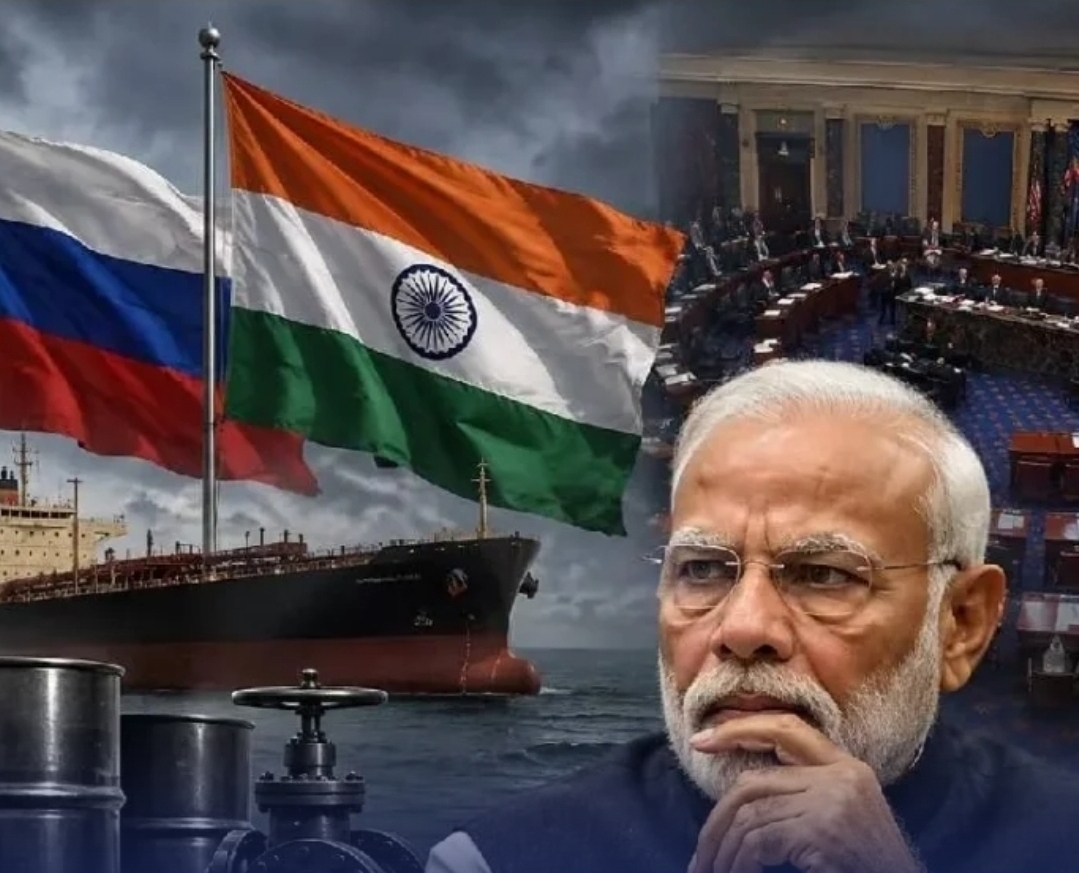
Washington: The US House of Representatives has moved forward with legislation that could give President Donald Trump sweeping authority to levy additional tariffs of as much as 100 per cent on imports from countries that continue to purchase Russian energy or are considered involved in sanctions evasion.
The measure, known as the Lindsey O. Graham Sanctioning Russia and Iran Act of 2026, cleared an important procedural stage in the House on Tuesday. Lawmakers voted 214-211 to approve a rule permitting consideration of Senate amendments to HR 5334. The vote was not a final decision on the legislation, with the House expected to take up the bill separately.
Under the version approved by the Senate, the President would have the power to impose additional duties of up to 100 per cent on products originating from countries that meet specified conditions related to Russian crude oil and natural gas purchases or assistance in circumventing sanctions.
The legislation is particularly significant for countries that rank among the largest buyers of Russian energy. India, which has substantially increased its dependence on Russian crude in recent years, could potentially come under the provisions. However, the bill itself would not automatically trigger a 100 per cent tariff on Indian exports. Instead, it would establish the legal authority for the administration to impose such duties, while leaving the decision on whether to act and what tariff rate to apply to the President.
The House Rules Committee also considered amendments aimed at changing the scope of the tariff provisions. A Democratic proposal from Representatives Steny Hoyer and Marcy Kaptur sought to explicitly identify India, China, Türkiye, Azerbaijan, Hungary, Slovakia, the UAE, Singapore, Kazakhstan and Kyrgyzstan as countries that could be subjected to duties of up to 100 per cent. Another proposal called for eliminating the secondary-tariff mechanism altogether. Neither amendment was cleared for consideration on the House floor.
The Senate approved the broader sanctions legislation on August 7 by an overwhelming 86-11 vote, reflecting substantial bipartisan support. Beyond Russia, the bill also contains provisions targeting Iran and seeks to strengthen measures against Russia’s leadership, energy industry and networks accused of helping Moscow evade international sanctions. The legislation also addresses vessels linked to Russia’s so-called shadow fleet.
The proposed tariff mechanism has nevertheless become a point of contention. Critics in Congress have questioned the extent of presidential discretion the measure would provide over trade policy. Some Democratic lawmakers have separately pushed for changes to the bill’s waiver provisions and other sections.
For India, the issue is particularly important because of the scale of its Russian crude purchases. Russia supplied approximately 30.3 per cent of India’s crude oil imports in FY2026, representing purchases worth around $40.8 billion.
The latest House action should therefore be viewed as a potential escalation in trade risk rather than an immediate tariff decision. If the legislation becomes law, the Trump administration could gain the authority to impose additional duties on countries meeting the statutory criteria. Whether India would ultimately face such measures, and at what level, would depend on subsequent decisions by the US administration.
